.png)
Water Scarcity to Water Security
Water risk is now a financial and operational risk, not just an environmental one. Learn how companies in India are building water resilience.
Water scarity is a growing financial and operational risk globally. The European Central Bank (ECB) estimates that a 1-in-100-year drought could put up to 24% of euro area economic output at risk. Companies that treat water management as pure compliance are increasingly exposed; those that build water security through efficiency, circularity, alternative sources and watershed-level thinking can strengthen both operational resilience and reputation.
.png)
Why is water risk a financial risk?
Water-related hazards, including surface water scarcity, droughts, and floods, pose material threats to macroeconomic stability rather than just affecting individual facilities. According to the ECB's research report, Nature at risk: Implications for the euro area economy and financial stability, around 72% of euro area non-financial corporations critically rely on at least one ecosystem service.
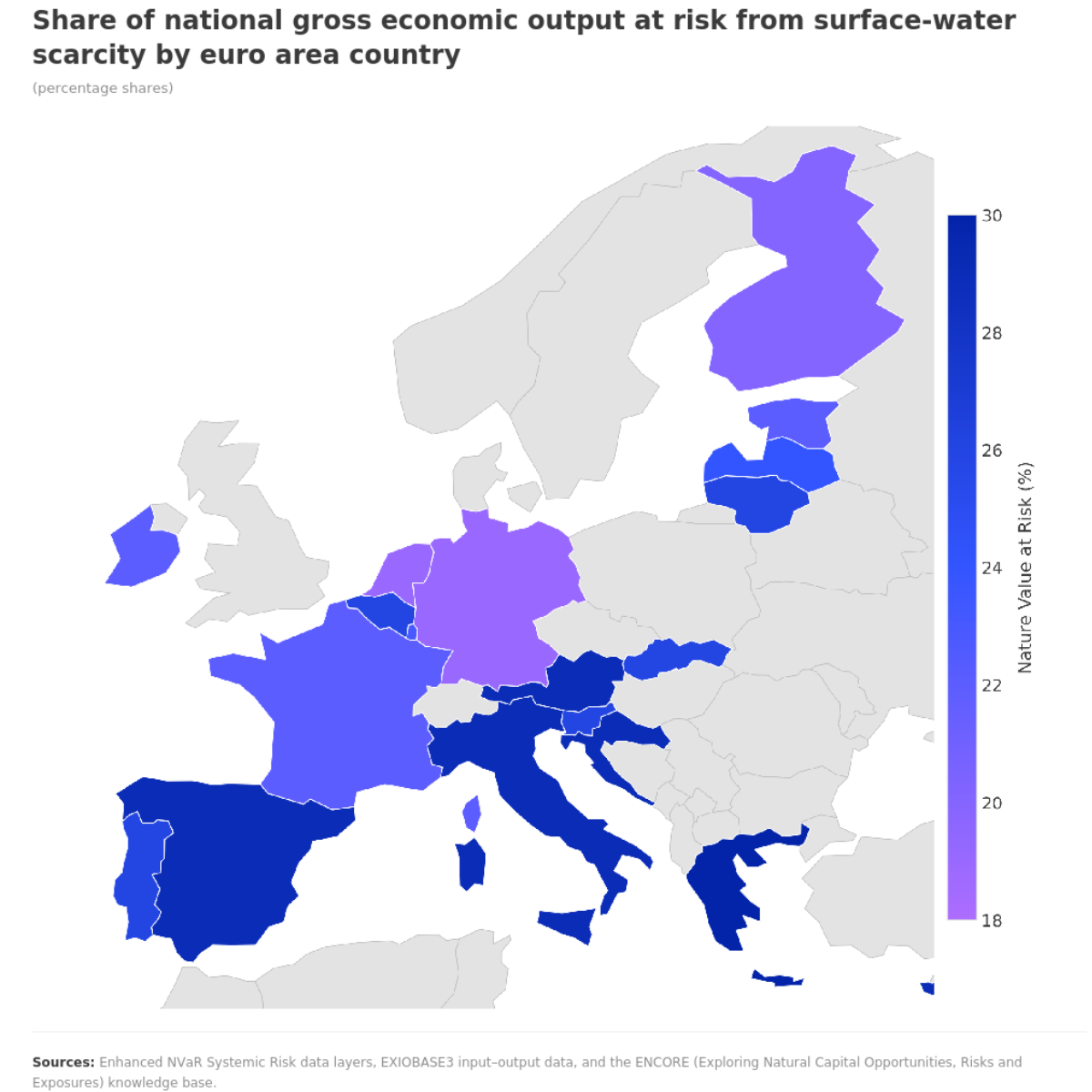
On the financing side, approximately 75% of corporate bank loans in the region are linked to these nature-dependent firms. Ecosystem degradation and biodiversity loss directly threaten macroeconomic stability and can fuel inflationary pressures. Environmental shocks do not stay contained to the site where they happen; they propagate quickly through supply chains and financial balance sheets.
What can India's industrial experience teach European companies?
SubbaRao from Murugappa Water Technology Solutions and Chola MS Risk Services, denxpert’s Inogen Alliance partner in India, explained during denxpert’s recent expert roundtable on corporate water risk that India presents a striking water paradox. The country receives substantial annual rainfall, but nearly all of it falls within just three months, and India hosts 18% of the world's population with only 4% of its water resources.
It is worth listening to his insights in full, not because Hungary or the wider EU faces identical conditions, but because Indian industry has already lived through the transition that European companies are only just beginning.
From Water Scarcity to Security: Corporate Water Risk Management Strategies – India Case Study
Because rampant groundwater extraction quickly affected surrounding communities, Indian industry experienced a fundamental shift where water availability moved from an environmental concern to an urgent business and reputational risk. Over roughly two and a half decades, this evolution progressed through distinct phases:
| Period | Main Focus | Strategic Objectives |
|---|---|---|
| 2006 - 2010 | Compliance & Regulation | Meeting discharge limits, mandatory regulations, and baseline compliance. |
| 2011 - 2015 | Efficiency, Reduction & Recycling | Driving "reduce and reuse" initiatives; lowering specific water consumption per unit of output. |
| 2016 - 2020 | Water Security & Vulnerability | Conducting source vulnerability assessments; ensuring 12-month operational continuity. |
| 2021 - 2026 | Water Stewardship & Aqua-Positive | Adopting watershed-level conservation, Alliance for Water Stewardship (AWS) certifications, and community basin regeneration. |
| Emerging Direction | Ecosystem-Wide Resilience | Integrating industry associations, government bodies, and supply chain cascading to achieve water-positive targets. |
What are the four core lessons for corporate water strategy?
Drawing on this trajectory and on the ECB's economic framework, EHS and sustainability professionals can build their water strategy around four practical pillars:
- Measure water dependency, not just water use: Shift tracking from absolute volume to specific consumption metrics, such as cubic metres of water per tonne of product. In service industries, track consumption per employee or per bed.
- Go beyond reduce and reuse: Follow the advanced water hierarchy of reducing, reusing, recycling, and repurposing. Treat municipal wastewater and secondary plant streams as viable alternative inputs for industrial cooling and other non-potable needs.
- Build alternative water sources: Mitigate reliance on a single, vulnerable source by integrating rainwater harvesting, closed-loop systems, groundwater recharge, and treated wastewater into operational infrastructure.
- Embrace watershed-level stewardship: Look beyond the facility fence line to evaluate local water balances. Engage neighboring communities and monitor supplier basin health to ensure long-term regional resilience.
How should companies modernize their water KPIs?
Traditional water KPIs focused solely on end-of-pipe compliance or basic consumption volumes. Leading organizations are now adopting a broader set of indicators to track real resilience:
| KPI Category | Core Focus | Description |
|---|---|---|
| Efficiency | Output-based intensity | Water consumption per unit of product or service. |
| Circularity | Alternative resource share | Percentage of wastewater reused and freshwater replaced by alternative streams. |
| Resilience | Drought continuity | Number of days operations can continue without primary water sources. |
| Basin Impact | Local water balance | Measurable changes in local water tables and watershed health. |
| Technology | Digital monitoring | Continuous, automated tracking of water reuse, recycling, and discharge metrics. |
Water security is no longer just about guaranteeing continuous supply. Building institutional maturity and digital infrastructure required to keep operating when water availability becomes uncertain is no longer negotiable. By connecting site-level water data, responsibilities, and automated workflows within a unified EHS and sustainability management platform, organizations can turn mounting water risk into a strategic operational advantage.
Watch the full expert presentation
The insights in this article are based in part on the presentation by Subbarao from Murugappa Water Technology Solutions and Chola MS, featured during denxpert's Corporate Water Risks webinar.
.png)
In the full video, Subbarao explores how Indian industry has moved from compliance and water efficiency towards water security, circularity, water stewardship and resilience, and shares lessons that can be applied to other water-stressed markets.