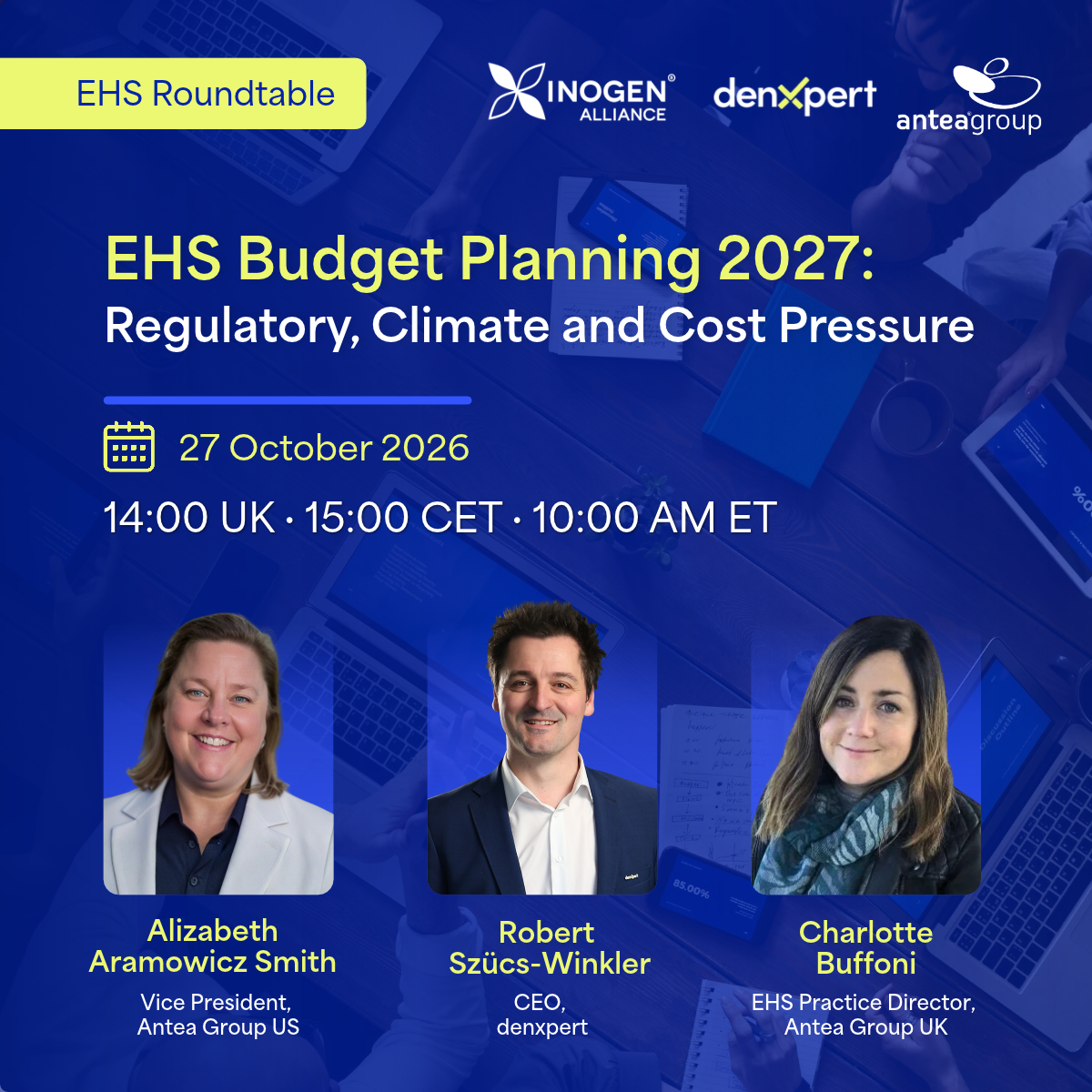
EHS Budget Planning 2027: Regulatory, Climate and Cost Pressure
Deadlines moved. Does that make your 2027 budget easier?
- There is no EHS headcount ratio: What both experts use instead to justify a role, a contractor or a committee.
- Delayed is not removed: ETS2 moved to 2028, the US heat standard is unfinished. What that changes for 2027.
- Emergency planning is becoming business continuity: Heat, smoke, flooding and power curtailment are now in scope.
- The permit triggers teams miss: New lines, capacity changes, new chemistry. Why the fine is the smallest cost.
- Compliance debt arrives with acquisitions: What due diligence skips, and how to budget for it in advance.
- Managing EHS across sites: See how regulations, permits and risk assessments are managed across multiple sites

Find Out What Belongs in Next Year's Budget, and What Doesn't

What a 2027 EHS budget has to absorb

EHS planning becomes more difficult when risks and requirements do not sit neatly within one budget line.
Workforce pressures can change the scope of risk assessments. Climate-related disruption can reshape emergency response planning. Regulatory amendments need to be tracked across jurisdictions. Changes to operations or ownership can trigger environmental permit reviews. And when a company acquires a new site, its existing EHS compliance gaps can quickly become part of your budget.
The question is not simply how much to spend on EHS in 2027.
It is what needs to be accounted for before the year begins.
This session brings together EHS specialists from the UK, US and Europe for a practical discussion of the issues that can affect your 2027 plans, followed by a short walkthrough of how regulatory requirements, permits and risk assessments can be managed across multiple sites.
Agenda
| Topic | What we'll expolre |
|---|---|
|
People & workforce |
Psychosocial risk baselines, headcount decisions, and the structures that work when headcount is not approved |
| Operational safety | What process safety spend can wait a year, and the argument that works with finance |
| Emergency & continuity planning |
Rewriting emergency scenarios for climate disruption, and where the money actually goes |
| Regulatory tracking & permits |
Central, local and hybrid models, audit cadence, and the changes that trigger a permit review |
| Growth & transactions |
EHS due diligence, the health and safety gap, and budgeting for inherited compliance debt |
|
Systems walkthrough |
Managing regulations, permit conditions, and risk assessments across multiple sites |
What you will take away
Built for EHS leaders who have to defend a 2027 number to finance, then deliver against it.
You'll gain practical insights into:
- Sizing EHS headcount by risk profile rather than ratios
- Making the case for a global psychosocial baseline
- Framing process safety spend in business-interruption terms
- Rewriting emergency plans for climate disruption and remote staff
- Choosing between central, local and hybrid regulatory tracking
- Catching permit triggers before CAPEX is signed off
- Budgeting for the EHS costs an acquisition brings with it
Who is the webinar for:
This discussion is particularly relevant for:
- Corporate, regional and group EHS/HSE leaders planning across multiple sites or countries
- EHS and compliance managers working in complex or higher-risk operations
- HSE department heads responsible for resource and budget planning
- Site-level EHS professionals contributing to risk assessments, compliance and operational planning
- EHS professionals involved in acquisitions, site expansions or property transactions
The discussion is especially relevant to organisations managing multiple sites, jurisdictions or operational risks, but the topics apply across industries.

Plan for what is actually coming
Your 2027 EHS budget should reflect more than last year's numbers.
Join the 60 minute discussion to explore the people, operational, regulatory and business changes that could shape your EHS priorities in 2027.
Register for free and receive the 2027 EHS Budget Template after the session.
FAQ
Who is this webinar for?
Primarily EHS leaders, compliance managers, HSE department heads, and site-level EHS coordinators involved in planning 2027 audits and budgets. It is also valuable for finance leaders and executives seeking a clearer view of the ROI and business case behind EHS spend.
Do I need to prepare anything in advance?
No advanced preparation is required. The webinar covers practical, immediately applicable approaches that you can apply directly to your own budget and audit planning process.
Will a recording be available if I can't attend live?
Yes! Every registered participant will receive the full recording and a concise summary by email shortly after the live session.
Our Experts