


.png)

The regulatory landscape governing European supply chains is undergoing a fundamental transformation. What was once treated as a voluntary corporate social responsibility (CSR) exercise has rapidly evolved into a strict, multi-layered framework of legal obligations. European and international businesses now face a "transparency wave" driven by converging directives and regulations that penalize opacity, environmental neglect, and human rights violations across all tiers of the supply chain.
In our recent co-hosted webinar with Deloitte Hungary, "Navigating Your Supply Chain Risks: Beyond CSDDD & EUDR," Anna Csonka (Senior Sustainability Reporting Expert at denxpert) and Réka Kálóczi-Szücs (Sustainability Service Line Leader at Deloitte) broke down the practical realities of complying with this dense matrix of European supply chain laws.
This playbook delivers actionable insights from that session, detailing how companies can move from reactive compliance to building an audit-proof, data-driven supply chain strategy.
1. The EU Transparency Wave: A Matrix of Converging Regulations
Navigating European supply chain due diligence requires understanding that compliance is no longer dictated by a single law. Instead, a matrix of overarching directives, sector-specific regulations, and product-level mandates intersect to hold companies accountable.
.png)
The Big Four Frameworks at play
CSDDD (Corporate Sustainability Due Diligence Directive)
Scope & Reach: Broad horizontal legislation targeting governance, human rights, and environmental due diligence across the value chain. Applies directly to large EU and non-EU companies meeting employee and turnover thresholds (e.g., 5,000 employees / €1.5 billion turnover transitioning down to 1,000 employees / €450 million turnover).
Key Enforcement Milestones: Passed in 2024, member states transpose into national law by mid-2026, with phased enforcement taking full effect between 2027 and 2029.
Supply Chain Impact: Even if your company falls below the direct legal thresholds, larger tier-1 clients will contractually pass down due diligence obligations through codes of conduct and supplier audits.
CBAM (Carbon Border Adjustment Mechanism)
Scope & Reach: Sector-specific mechanism targeting carbon-intensive imports. Applies to EU importers of cement, iron, steel, aluminium, fertilizers, electricity, and hydrogen exceeding 50 tonnes per year.
Key Enforcement Milestones: Definitive financial phase starts January 2026, requiring verified carbon certificates.
Supply Chain Impact: Requires direct, verified primary carbon emissions data from non-EU suppliers. If suppliers fail to deliver verified data, punitive EU default carbon values apply, severely eroding product margins.
EUDR (EU Deforestation Regulation)
Scope & Reach: Commodity-specific regulation with no company size threshold. Applies to anyone placing cattle, cocoa, coffee, palm oil, rubber, soy, or wood (and derived products) on the EU market.
Key Enforcement Milestones: Full enforcement phase begins late 2025/2026.
Supply Chain Impact: Demands precise plot-level geolocation data proving products originate from land not subject to deforestation post-December 2020.
FLR (Forced Labour Regulation)
Scope & Reach: Exceptionally broad scope covering all products, all sectors, and all company sizes.
Key Enforcement Milestones: Entered into force December 2024; EC risk database prepared; full enforcement by late 2027.
Supply Chain Impact: Allows EU customs authorities to ban and confiscate any product at the border if forced labour is identified at any tier of its production chain.
.png)
2. The Operational Ripple Effect: How Regulations Hit Your Desk Today
While regulatory timelines stretch out over the coming years, commercial impacts are happening immediately. Due diligence is cascading down corporate value chains through buyer-supplier contracts and procurement requirements.
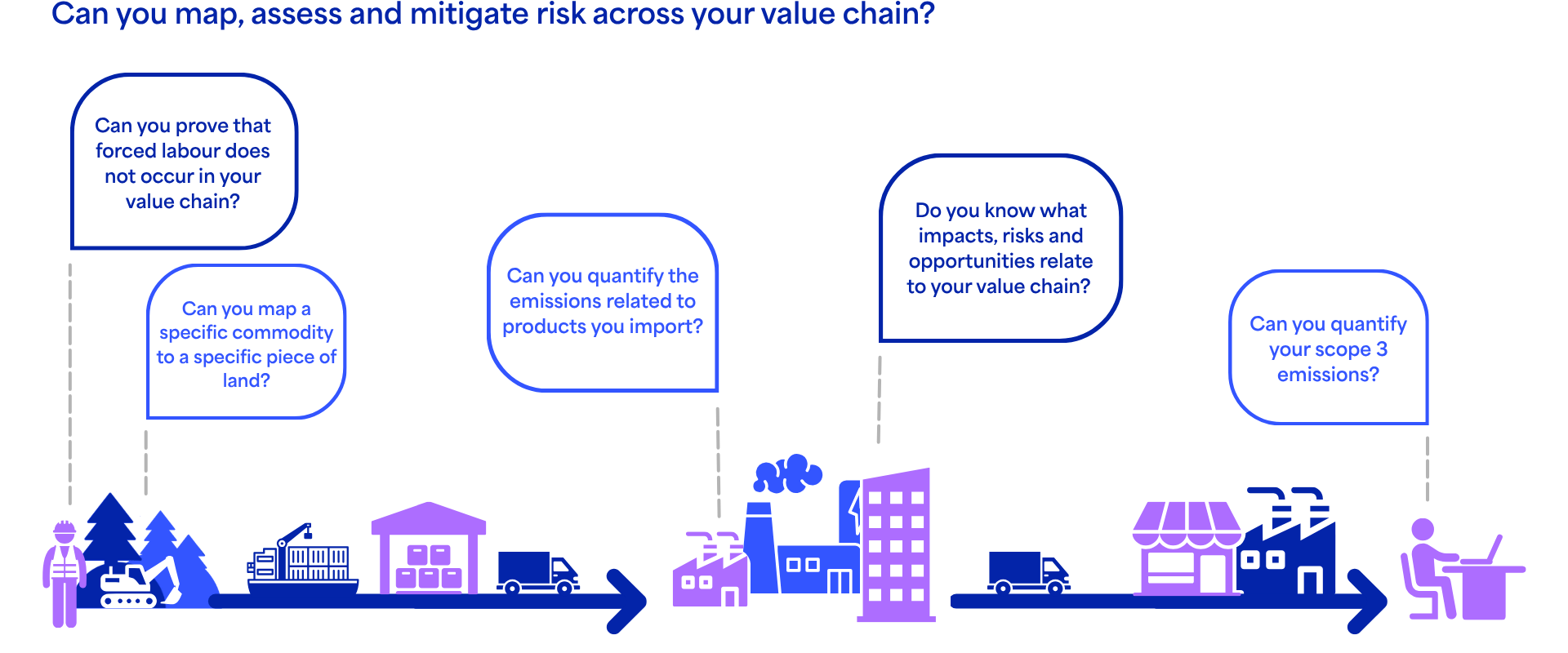
If you are a supplier to EU enterprises, you are likely receiving an influx of operational requests:
- Supplier Questionnaires & Codes of Conduct: Driven directly by client CSDDD readiness.
- EcoVadis & ESG Rating Demands: Triggered by client obligations under CSRD and supply chain risk assessments.
- Product Carbon Footprints (PCF) & Scope 3 Data Forms: Required to support client net-zero targets and CBAM compliance.
- Geolocation & Plot Tracing Declarations: Demanded by buyers under EUDR to avoid product rejection.
- Audit Right Clauses & Forced Labour Attestations: Inserted into purchasing contracts to safeguard against FLR enforcement.
3. From Compliance to Competitive Advantage: Practical Step-by-Step Execution
Treating supply chain due diligence purely as a "box-ticking" exercise leads to administrative bottlenecks and unmitigated risk. As highlighted during the webinar, mature organizations use a structured, 5-step methodology to integrate supply chain governance into core operations:

Step 1: Map Your Extended Value Chain
Identify not only your direct (Tier-1) suppliers, but also critical Tier-N suppliers supplying high-risk materials (e.g., timber, rubber, raw metals).
Step 2: Conduct Risk-Based Prioritization
You cannot audit every supplier at once. Categorize suppliers by:
- Geographic risk (e.g., regions with documented labour issues).
- Sector/Material risk (e.g., deforestation-linked commodities, carbon-heavy goods).
- Spend volume and operational criticality.
Step 3: Streamline Supplier Engagement
Avoid overwhelming supply partners with repetitive, disconnected spreadsheets. Standardize questionnaires, establish clear supplier codes of conduct, and provide training where necessary.
Step 4: Implement a Unified Digital Architecture
Relying on manual spreadsheets and email threads creates severe audit risks, version control errors, and data loss. A dedicated platform like denxpert centralizes narrative disclosures, numeric emissions data, supplier risk scoring, and document verification into a single audit-proof source of truth.
Step 5: Establish Continuous Monitoring & Remediation
Due diligence is an ongoing cycle. Set up automated workflows to track expiring certificates, trigger re-assessments when risks change, and document corrective action plans.
4. Frequently Asked Questions
What is the main difference between CSDDD and CSRD?
CSRD (Corporate Sustainability Reporting Directive) is primarily a disclosure standard requiring companies to report on their environmental and social impacts, risks, and opportunities using double materiality principles. CSDDD (Corporate Sustainability Due Diligence Directive) is an action-oriented governance mandate requiring companies to actively identify, prevent, mitigate, and account for negative human rights and environmental impacts across their value chains.
How does EUDR affect non-EU suppliers exporting to Europe?
Non-EU suppliers sending relevant commodities (e.g., wood, rubber, cocoa, coffee) to the EU market must provide precise geolocation data for the land where the raw materials were produced. Without verifiable proof that the land was not subject to deforestation after December 31, 2020, products cannot clear EU customs.
What happens if a supplier fails to provide carbon data for CBAM?
If a supplier fails to provide verified primary carbon emissions data for CBAM-covered goods, European importers are forced to apply strict EU default carbon values. These default values carry high penalizing carbon costs, making unverified suppliers commercially uncompetitive.
👉 Ready to transform your supply chain compliance into a strategic advantage? Book a personalized denxpert demo today and see our platform in action!



.png)