



For global HQs, the days of managing multi-site EHS compliance with flat, standardized "level-one" templates are over. Despite headlines tracking a Western "ESG backlash," multinational industrial and technology sectors face a tightening regulatory environment on two fronts.
International trade borders are penalizing unverified carbon metrics, while regional, facility-level environmental and safety rules are rapidly evolving. HQs relying on manual spreadsheets or broad domestic exemptions face severe balance sheet exposure.
To help organizations close the dangerous gap between compliance on paper and reality on the ground, Alizabeth Aramowicz Smith (VP at Antea Group USA) and Robert Szücs-Winkler (CEO of Denxpert) unpacked the modern regulatory landscape in a recent global EHS compliance webinar.
This guide details how forward-thinking HQs are accelerating their compliance status, mitigating cross-border financial risk, and transforming regulatory data overhead into a tangible market advantage.
The Myth of "Compliance Harmony": A Tale of Two Regulatory Directions
The most critical mistake a compliance officer or CFO can make is assuming that the easing of regulations in one geographic region offsets or balances out tightening rules in another. Divergence is the new operational reality. Consider the current friction between European import barriers and emerging Asian production markets like India:
- Battle on two fronts: In Europe, the CSRD and the CBAM apply strict financial penalties directly to embedded carbon emissions at the EU border. With definitive certificate pricing trending at €75.36 per tonne of CO2, there are direct tariff impacts. Importers who cannot provide verified carbon tracking data from foreign suppliers are hit with harsh "default value" penalties. For instance, importing unverified Indian steel into the EU under this pricing structure translates to an automatic border penalty of up to €254 per tonne of steel, instantly wiping out manufacturing margins.
- The Local Surge: Simultaneously, India's regulatory machinery has systematically scaled its mandates, completely independent of Western recalibrations. The Securities and Exchange Board of India (SEBI) has expanded its BRSR Core requirements. Under the current cycle, it is now legally mandatory for the top 1,000 listed companies by market capitalisation to report and obtain mandatory reasonable assurance (third-party audits) on these sustainability metrics.
Why this matters to HQ:
An Indian facility exporting steel, aluminium, or electronic components to Europe cannot rely on domestic exemptions or local carve-outs to save them in foreign markets. EU client Request for Proposal (RFP) requirements apply regardless of local exemptions. In practice, your international sites must meet the higher of the two standards to survive.
The cost of missing this alignment is already visible: anticipation of CBAM metrics caused an immediate 24.4% drop in steel and aluminium exports from India to the EU in recent trade cycles, demonstrating that missing carbon and sustainability data has become an active barrier to international trade.
Why "Flat Templates" Fail at the Facility Level
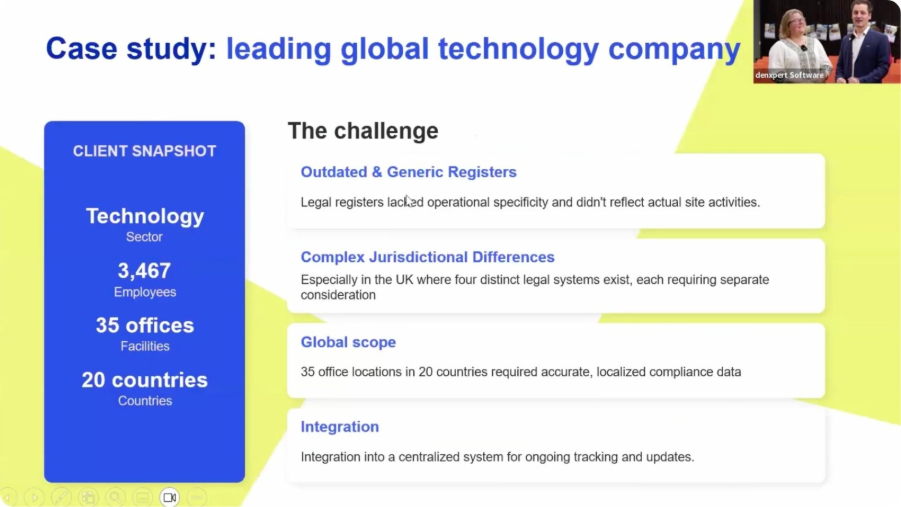
Many corporate HQs attempt to address these fragmented regulations by issuing standardised corporate templates. An executive team in the US or Western Europe creates an Emergency Response Plan, an occupational health framework, or an ISO 14001 checklist, pushes it out to 30 sites worldwide via email, and checks the box.
But when third-party objective auditors or regulatory inspectors enter those local facilities, they inevitably find that the system is misfiring.
The issue isn't a lack of intent or operational goodwill; it's a lack of localised granularity.
Corporate self-assessments frequently look fantastic on paper ("all green" dashboards) because local facility managers do not fully comprehend the granular nuances of regional laws. They look at a corporate checklist and answer based on their assumptions, not local legal reality.
Case in Point: Jurisdictional Deep-Dives
- Emergency Response: A corporate template may outline an excellent general evacuation plan stating that one drill per year is sufficient (common in the US). However, a local site in France or India is legally mandated to run exactly two physical evacuations per year, and all safety documentation must be kept in the local language. By enforcing an unmodified corporate template, HQ accidentally trains its sites to be non-compliant.
- Occupational Health: In Italy, specific occupational safety training is legally required to occur before employment begins (Day 0)—not within the standard 30- or 60-day onboarding window used in North America. Missing this deadline creates immediate corporate liability.
- Waste Management: In countries like Spain, Mexico, Canada, and Australia, the operative environmental and waste legislation sits firmly at the state, provincial, regional, or even municipal level rather than the federal tier. For example, Spain's waste laws live at the state level, and Switzerland's cantonal-level laws differ dramatically by canton. A compliance program built only around national-level law leaves local facilities entirely exposed to regional enforcement actions.
Up-skilling the Value Chain: Managing Scope 3 Risk
The next major pain point hitting corporate balance sheets is the value chain data gap. International buyers are no longer content with Scope 1 (direct) and Scope 2 (indirect energy) data; they are demanding granular, product-level Scope 3 metrics from your third-party vendors and downstream supply chains.
Yet, the typical mid-sized or small manufacturing vendor (MSME) in your supply chain is already drowning under an estimated 1,450 compliance obligations annually, straining under high local regulatory costs. Expecting them to seamlessly generate flawless, audit-ready carbon-intensity data without corporate support is an operational fantasy.
The Strategy: Leverage Your Trusted Trader Architecture.
If your organization utilizes Authorized Economic Operator (AEO) status or similar trusted trader frameworks to streamline customs, logistics, and physical security, you already possess a robust data governance mechanism.
While AEO status itself will not exempt your products from carbon tariffs or environmental financial obligations like CBAM, you can leverage your existing AEO compliance infrastructure to gather, verify, and track the environmental data that international clients demand.
Leading multinationals are no longer outsourcing this problem or threatening vendors with termination. Instead, they are proactively running supplier capacity programs, co-designing simplified data intake templates with key local partners, and directly linking verified ESG metrics to corporate procurement choices.

The ISO 14001:2025 Transformation: Executive Board Liability
The compliance playground changed structurally with the finalisation of the ISO 14001:2025 update. HQ teams must realise that this revision brings environmental management systems out of the back office and into direct alignment with hard corporate governance.
The revised standard introduces requirements that bring it closer to binding ESG reporting: biodiversity impact assessments, life-cycle thinking for products, and carbon-related environmental impacts are now embedded in what environmental management systems (EMS) must address.
But the more consequential change is organisational. The previous version asked companies to have a process in place to ensure legal compliance. The updated standard requires that the organisation itself works in a way to ensure compliance.
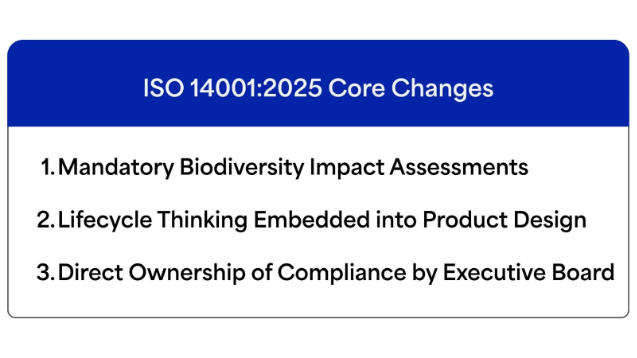
This represents a meaningful shift in ownership. Executive management can no longer simply delegate the role to an isolated EHS representative and review a list once a year.
The board and executive management itself are now directly responsible for owning the entire process. It must be a lived, operational reality. This is especially urgent in regions like Europe, where directives (such as the Industrial Emissions Directive and Energy Efficiency Directive) are making certified ISO 14001 and ISO 50001 compliance mandatory to retain operational permits.
The AI and Software Playbook: Turning Regulatory Noise into Actionable Data
Trying to manually monitor compliance across dozens of sites in multiple countries is a recipe for operational paralysis. In any given month, sitting parliaments and regional bodies publish a torrent of new decrees. If you stream that information raw to your EHS managers, it quickly transforms into blinding background noise.
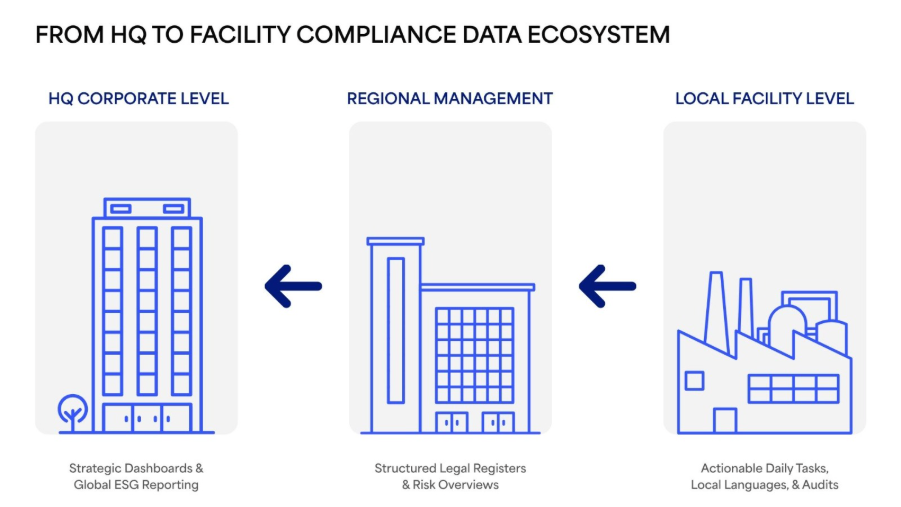
To stay ahead, modern HQs are utilising an integrated, platform-based approach that combines specialised EHS software, global consultant networks, and targeted AI agents.
Step 1: Synthesise with "Think Global, Deliver Local" Networks
Instead of executing 30 individual contracts with 30 separate compliance consultancies around the world, HQs are utilising unified international networks, such as the Inogen Alliance. This gives HQs a single, centralised corporate contract and one point of contact, drastically minimising administrative drag while ensuring that an expert who speaks the local language is physically auditing the local facility.
Step 2: Transition from Flat Registers to Dynamic Software Platforms
Ditch flat spreadsheets for software-as-a-service (SaaS) platforms like denxpert, which unify the dual pillars of an EHS legal compliance suite and an ESG data-collection suite.
An integrated data management ecosystem recognises that your regulations are interconnected:
- Your local EHS legal registers feed your site risk assessments.
- Your environmental disclosures generate the baseline required for carbon trading systems. For example, India's Principle 6 BRSR disclosures establish the exact emissions baselines required for the Carbon Credit Trading Scheme (CCTS), which mandates compliance and emissions-intensity targets across heavy industrial sectors (including steel, aluminium, cement, and pulp/paper).
- Your local waste tracking and material consumption metrics naturally build out the supply chain data demands required for global Extended Producer Responsibility (EPR) and CSRD reporting.
Step 3: Implement Guardrailed AI Agents
HQs can successfully deploy customised AI Agents to crawl government web portals and daily legislative updates. Instead of dumping thousands of raw pages on an EHS manager, the agent filters the legislation, flags specific text relevant to your industry, and generates an automated warning only when an incoming law threatens to disrupt an active facility's permit structure. EHS professionals can then cross-examine the output to eliminate potential AI hallucinations, significantly accelerating response times.
Conclusion: Sustainability Data is Business Evidence
The global regulatory environment will continue to expand, completely independent of shifting political tides in Washington, Brussels, or New Delhi. The physical realities of resource scarcity, supply chain disruptions, and carbon taxation are already showing up directly on corporate income statements.
Treating EHS and ESG as an isolated, domestic "box-ticking" exercise is an operational failure. The corporate leaders winning the next decade are building integrated data architectures that treat sustainability metrics for what they truly are: core business arguments backed by hard evidence.
Is your HQ building the infrastructure to keep pace, or is your value chain exposed to the pincer movement?
Frequently Asked Questions for Global HQs
Q: Can our existing AEO status exempt our overseas shipments from CBAM carbon costs?
A: No. AEO status streamlines customs clearance, logistics, and physical security checks, but it does not exempt a company from environmental financial penalties or carbon border pricing. However, the data governance models built to maintain AEO compliance provide the ideal structural framework for gathering the exact product-level carbon metrics international buyers now demand.
Q: Why do corporate EHS templates often cause local non-compliance?
A: Corporate-level templates frequently prioritise a flat, standardised framework (e.g., conducting one evacuation drill per year). However, they fail to account for jurisdiction-specific frequencies. For instance, countries like France and India legally mandate two physical evacuation drills annually. Moving unmodified templates to local sites inadvertently trains facilities to operate outside of local law.
Q: How do we prevent our local sites from reporting flawed or non-compliant EHS data back to HQ?
A: Move away from regional-level oversight and deploy local EHS legal registers directly to the individual facility level. Ensure your data tracking utilises a unified SaaS platform featuring standardised metric units, and back your digital platform with local, native-speaking auditors who understand the distinct intent and spirit of regional laws.
Q: How do the ISO 14001:2025 updates affect corporate board liability?
A: The revised standard eliminates passive delegation. Executive leadership can no longer simply appoint an EHS manager to handle compliance. The board and executive management are now directly responsible for ensuring that compliance is integrated into the core operations of the organisation, making legal adherence a core component of corporate governance audits.
Q: What is the specific financial risk of ignoring India's CCTS and SEBI BRSR alignment for EU exports?
A: Under India's CCTS (governed by the Bureau of Energy Efficiency), heavy industries are legally bound to strict greenhouse gas emissions-intensity targets. If a facility ignores these baselines while exporting to Europe, they run directly into the EU's CBAM default penalties. With EU carbon pricing at €75.36 per tonne, failing to deliver verified data triggers a border penalty of up to €254 per tonne on products like steel, completely destroying the asset's cross-border profit margin.

Denxpert is an EHS and ESG software management company and member of the Inogen Alliance, a global network of 75+ sustainability and compliance consultancies operating in over 150 countries. This blog draws on insights shared in a Denxpert webinar featuring Elisabeth Aramovic-Smith (Antea Group USA) and Robert Szücs-Winkler (Denxpert).
Interested in reviewing your global EHS compliance setup?
Get in touch with the Danxpert team.


.png)



.png)