- COP31 ended on November 22, 2026 without the Antalya Pact after talks deadlocked over fossil fuel language.
- The COP31 outcome does not change CSRD, CBAM, EUDR or CSDDD obligations or deadlines.
- Adaptation finance was deferred to COP32 in Addis Ababa in 2027.
- The 35x35 electrification pledge survived as a voluntary commitment.
- Banks increasingly need site-level climate risk and water data to finance projects.
- Collect site data once and reuse it for reporting and financing.

COP31 outcome for business: what actually changed?
COP31 ended without a global agreement. But for European businesses, the more important question is what happens next.
The COP31 outcome for business does not change existing EU reporting obligations. CSRD, CBAM and EUDR requirements continue to follow their own legislative timelines, regardless of what happened in Antalya.
What did change is the context in which companies are expected to manage sustainability. Climate finance remains difficult to access, and banks, investors and major customers increasingly need reliable evidence of climate risks, resource use and decarbonisation measures.
For EHS and sustainability teams, the practical implication is clear: the priority is not a new reporting deadline. It is making existing data reliable enough to support business decisions.
What was the COP31 outcome?
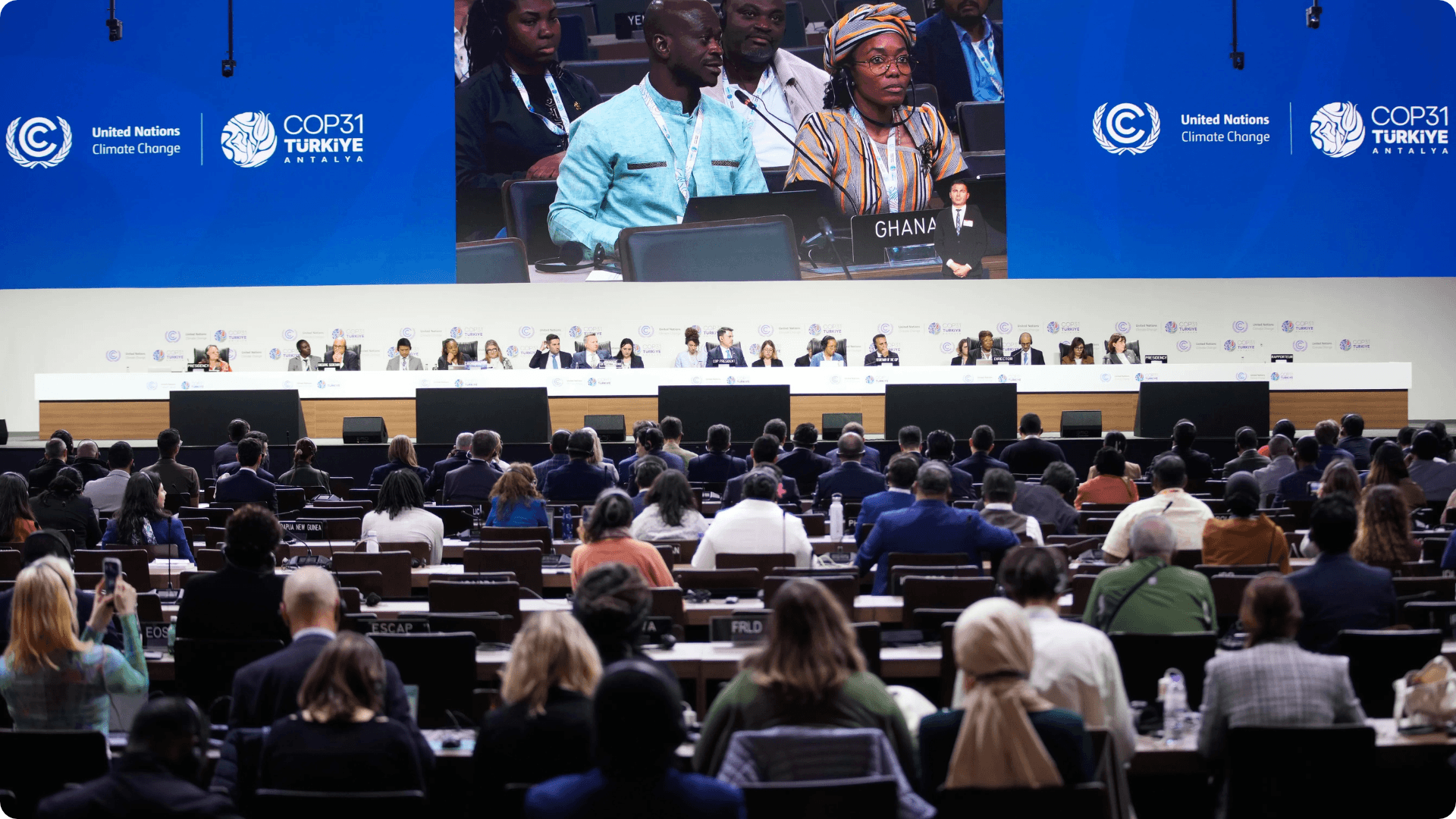
COP31 ended in Antalya, Türkiye, on November 22, 2026, without adopting its proposed closing decision, known as the Antalya Pact.
The summit ran approximately two days beyond its scheduled closing date. Delegates could not reach consensus on the final text, which had removed references to transitioning away from fossil fuels.

The European Union, the United Kingdom and several developing countries objected to the proposed wording. The EU argued that the text did not adequately address the transition away from fossil fuels. Panama and the Marshall Islands also raised objections. Under the UN climate process, decisions are adopted by consensus. The failure to agree meant that the Antalya Pact was not adopted. Read more about the closing decision.
For businesses, however, the outcome is more nuanced than the headline suggests. COP31 did not produce the expected political agreement, but several decisions, voluntary commitments and investment initiatives continued independently of the failed closing text.
How the Antalya Pact changed during negotiations
The proposed agreement became less ambitious over the course of the summit.
| Issue | First draft: November 16 |
Second draft: November 19
|
Final outcome: November 22 |
|---|---|---|---|
| Fossil fuels | Called for a faster transition away from fossil fuels | References removed |
Disagreement over fossil fuels prevented consensus
|
| Adaptation finance | Proposed at least $120 billion annually by 2035 | Replaced with a roadmap | Financing decision deferred to COP32 |
| Electrification | Included the 35x35 pledge | Retained |
Survived as a voluntary commitment
|
The unresolved issues will continue into the next round of negotiations. COP32 is scheduled to take place in Addis Ababa, Ethiopia, in 2027, with the next formal negotiating session planned for Bonn in June 2027.
What did COP31 actually agree on?
Although the Antalya Pact was not adopted, COP31 produced several decisions and initiatives.
These included decisions on the Just Transition Work Programme, the Adaptation Fund, carbon markets and transparency. Voluntary commitments and investment platforms announced during the summit also remained in place.
Electrification: the 35x35 pledge
The 35x35 pledge aims to increase electricity's share of global final energy consumption from approximately 23% today to 35% by 2035.
The commitment is voluntary. It does not establish binding national targets or introduce new reporting obligations for companies. It also does not specify that the additional electricity must come from renewable or other low-carbon sources.
Industrial decarbonisation: investment continues
COP31 also saw the expansion of the Türkiye Industrial Decarbonization Investment Platform.
The European Investment Bank, Asian Development Bank, Islamic Development Bank and Italy's Cassa Depositi e Prestiti joined the initiative. The European Commission also signed on. The platform aims to mobilise €5 billion in investment by 2030, initially focusing on steel, aluminium, cement and fertiliser, with glass and ceramics added during COP31. The initiative illustrates an important distinction: the failure to agree on a global political text did not stop investment in industrial decarbonisation.
Does the COP31 outcome for business change EU reporting rules?
No. The COP31 outcome for business does not change EU sustainability reporting requirements, compliance deadlines or the scope of existing obligations.
Their requirements are amended through the EU legislative process, not through decisions at a UN climate conference. A COP decision can influence the direction of future climate policy. It cannot, by itself, amend an EU directive or regulation, change a delegated act or move a reporting deadline. For companies preparing their sustainability reporting, the relevant developments remain the EU's Omnibus process and the delegated acts introducing the European Sustainability Reporting Standards (ESRS).
In practical terms, a company preparing its sustainability statement on November 21 would not need to change its reporting plan because of the outcome in Antalya.
The key distinction is between international climate negotiations and the legislation that determines what companies must do. For EHS and sustainability teams, the practical next step is to review their obligations against the latest applicable EU texts, rather than interpreting summit headlines as regulatory updates.
Why climate finance matters to businesses
One of the most significant changes between the COP31 drafts concerned adaptation finance. The first draft proposed at least $120 billion in annual adaptation finance by 2035. The second draft replaced the figure with a roadmap, and the final negotiations deferred the issue to COP32.
The financing gap remains substantial.
The UNEP Adaptation Gap Report 2026 estimates that developing countries will need approximately $305 billion annually for adaptation by 2035. International public adaptation finance reached an estimated $28.2 billion to $31.7 billion in 2024, only around $1 billion more than in 2023. Even if public finance triples by 2035, it would cover only 20–29% of estimated adaptation needs.
What does this mean for companies seeking climate finance?
When public funding is limited, more climate investment must be channelled through commercial banks, development institutions and national investment platforms. These institutions need to assess whether a project is financially viable, whether the risks are understood and whether the expected environmental benefits can be demonstrated.
A bankable project therefore requires more than a sustainability ambition. It needs:
- Clear and credible cash-flow projections.
- A well-defined contractual structure.
- Evidence of the risks involved and how they will be managed.
- Measurable environmental or emissions outcomes.
- Reliable data to support the investment case.
The European Investment Bank's €100 million facility for Eximbank Hungary, announced in November, is one example of financing available for corporate energy-efficiency and renewable-energy projects. The opportunity is not limited to companies with large sustainability departments. Businesses that can demonstrate their risks, investment needs and expected results are better positioned to prepare projects for financing.
COP31 and the growing importance of water risk data
Water was a recurring topic in climate finance discussions in Antalya. It is also becoming an increasingly important consideration for financial institutions assessing physical climate risk.

The European Central Bank has modelled the potential impact of severe drought on the euro area economy. Under a drought with a 100-year return period, surface water scarcity could expose up to 24% of euro area output. The corresponding figure for groundwater scarcity could reach 30%.
The financial exposure is also significant. More than 34% of euro area bank lending to companies, representing over €1.3 trillion, is directed towards sectors with high water-scarcity risk. Read the ECB's analysis of water-related financial risk. For a bank assessing a company's exposure, the location of its headquarters tells only part of the story. The relevant information is often found at individual production sites, in key supplier locations and across the water catchments on which operations depend.
Yet many companies still collect water and energy data through site-level spreadsheets designed primarily for permit compliance. These records may not be structured to support climate-risk assessments, investment decisions or supplier risk analysis. A system that already tracks water use and air emissions against permits and limits can provide a stronger starting point. Companies still need to connect that operational data to site locations, physical risks and the business consequences of disruption.
The goal is not simply to collect more data. It is to understand what the data means for the business.
What should businesses do before COP32?
The COP31 outcome for business points to a practical priority for 2027: make sustainability and operational data reliable enough to support compliance, risk management and investment decisions.
Companies can start with six steps.
1. Confirm your reporting obligations
Review your CSRD reporting scope, CBAM obligations and EUDR exposure against the latest applicable EU legislation.
Do not assume that a political statement or an international summit changes a legal requirement.
2. Map physical climate risks to sites
Identify production facilities and key suppliers located in water-stressed or otherwise climate-vulnerable areas.
For each location, assess the potential business consequences, such as production downtime, lost output or delayed shipments.
3. Connect risks, actions and results
Record each material risk alongside the measures taken to address it and the results achieved.
This creates a clearer evidence trail for auditors, customers and financial institutions.
4. Prepare an investment project for financing
Identify a planned energy-efficiency, renewable-energy or adaptation project that may require external funding.
Document its financial assumptions, contractual structure, expected emissions impact and risk mitigation measures.
5. Prepare for sustainability questions from customers
Companies in CBAM-covered sectors and other supply chains may need to provide increasingly detailed product and supplier information.
The same applies to sustainability questionnaires and due diligence requests from larger customers. Read more about EU supply chain due diligence.
6. Collect data once and reuse it
Site-level environmental data can support several business processes, including ESRS reporting, supplier questionnaires, permit compliance and financing applications.
However, this is only possible when the data is consistently structured, traceable and connected to the relevant requirements. Companies should avoid creating separate reporting processes for every new request. A more efficient approach is to establish a reliable data foundation that can serve multiple purposes.
How better sustainability data supports reporting and business decisions
Reliable sustainability data is not only a requirement for large multinational companies.
ANY Security Printing, a Hungarian security printing company, moved from spreadsheet-based reporting to a centralised platform within a year. The company mapped its reporting datapoints to ESRS requirements. According to the published case study, the new approach saved 75% of working hours and freed up the equivalent of six people's multi-week workload during reporting cycles. The example shows how structured sustainability data can reduce reporting effort while improving the consistency and traceability of information.
The same principle applies beyond reporting. Data collected for operational compliance can also support climate-risk assessments, customer requests and financing discussions when it is managed in a reusable format.
What the COP31 outcome means for business
COP31 ended without the Antalya Pact, but the absence of a global agreement does not mean that climate-related business requirements have stopped evolving. For European companies, the immediate compliance calendar remains unchanged. The more significant development is the continued demand for credible evidence from banks, investors and customers. Businesses need to understand their environmental risks, demonstrate the measures they are taking and connect sustainability performance to operational and financial decisions. That starts with reliable data.
denxpert helps organisations bring EHS and sustainability processes, data and compliance workflows together in one platform. By connecting operational information with sustainability reporting, companies can reduce fragmented data collection and build a more consistent foundation for compliance and business decisions.
Explore denxpert
Bring your EHS and Sustainability processes, data and compliance workflows together in one platform. Explore denxpert's EHS & ESG software
Have questions about your EHS & Sustainability needs?
Talk to our team about your current processes and challenges. Talk to an expert
Frequently asked questions
Did COP31 fail?
COP31 failed to adopt its proposed closing decision, the Antalya Pact, on November 22, 2026. The disagreement centred on the omission of references to transitioning away from fossil fuels. However, other decisions were adopted, and voluntary commitments and investment initiatives announced during the summit remained in place.
What was the Antalya Pact?
The Antalya Pact was the proposed closing decision of COP31, intended to summarise the political agreement reached at the conference. Earlier drafts included a call to accelerate the transition away from fossil fuels and proposed at least $120 billion in annual adaptation finance by 2035. Both elements were removed during negotiations, and the final package was not adopted.
Does the COP31 outcome affect CSRD or CBAM deadlines?
No. CSRD and CBAM are EU legislative instruments, and their requirements are determined through the EU legislative process. COP31 does not amend EU legislation or change reporting deadlines. Companies should monitor applicable EU legal texts and implementation timelines.
Does COP31 change EUDR or CSDDD requirements?
No. The EU Deforestation Regulation and Corporate Sustainability Due Diligence Directive are governed by EU legislation. The outcome of COP31 does not change their requirements or implementation timelines.
What is the 35x35 electrification pledge?
The 35x35 pledge is a voluntary commitment to increase electricity's share of global final energy consumption from approximately 23% to 35% by 2035. It does not establish binding national targets or introduce new company reporting obligations.
When and where is COP32?
COP32 is scheduled to take place in Addis Ababa, Ethiopia, in 2027. Issues left unresolved at COP31, including adaptation finance and elements of the just transition process, are expected to continue there. The next formal negotiating session is planned for Bonn in June 2027.
What should companies do after COP31?
Companies should confirm their current regulatory obligations, map climate risks to operational sites and key suppliers, improve the traceability of sustainability data, and prepare investment projects with clear financial and environmental evidence.
The most useful preparation is to build a data foundation that supports compliance, risk management and business decisions at the same time.